Refractive surgery
LASIK or Trans-PRK: what decides the choice?
Corneal thickness, degree of correction, sport, occupation. The factors that actually steer the decision.
Read the article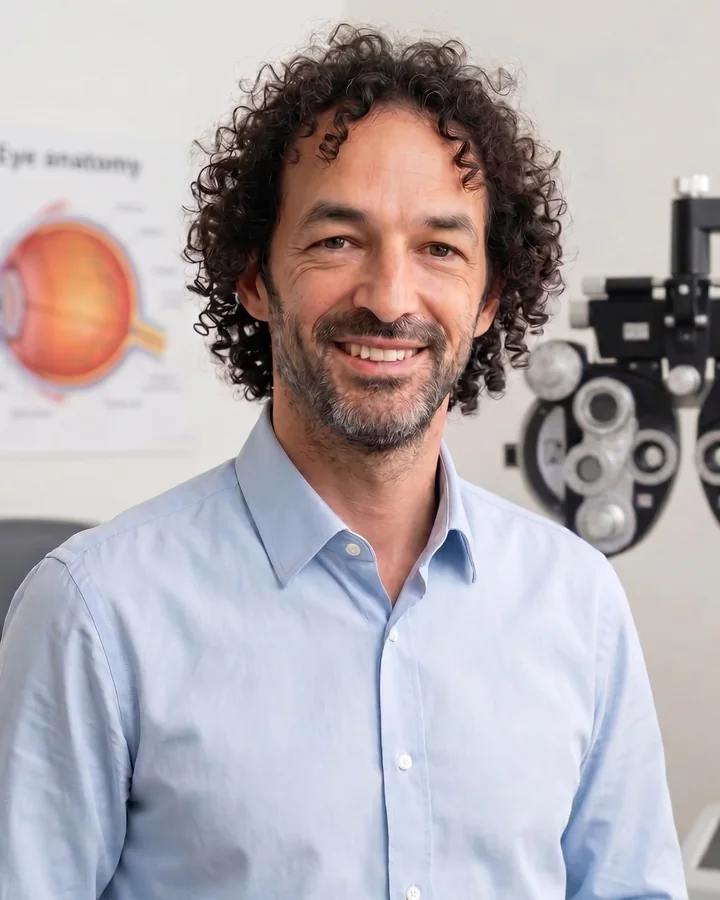
Dr Emmanuel Halimi Refractive surgery Cataract surgery
In Rueil-Malmaison and Paris: a full assessment, a technique chosen for your eye, and a decision you make fully informed.
The surgeon
Dr Emmanuel Halimi performs refractive surgery (LASIK, SMILE, Trans-PRK, ICL phakic lenses, PreLex) and cataract surgery. He sees patients in Rueil-Malmaison and operates at Clinique Les Martinets and at Institut Voltaire in Paris.
His practice rests on a simple principle: no procedure is offered before a full assessment, and no technique is applied by default. The shape of your cornea, its thickness, your age and the way you live together determine what is suitable and, sometimes, what is not.
He is a member of Terres d'Ophtalmo, an NGO of volunteer ophthalmologists working against avoidable blindness.
Where to start
Needs change with age, and so do the techniques. Here are four reference points to help you know where to start. They do not replace an assessment.
Myopia, hyperopia and astigmatism are corrected by laser on the cornea, or with a lens implant if the cornea is not suitable. Provided your vision has been stable for two years.
LASIK, SMILE, Trans-PRK, ICL → Age 45 to 54 Presbyopia sets inYour arms start to feel too short. The natural lens is still clear: the cornea can be made multifocal, or a slight difference can be set between the two eyes.
PresbyLASIK → Age 55 to 64 The natural lens stiffensReplacing a lens that is still clear but has become rigid corrects presbyopia and rules out cataract for good. It is the cataract operation, done earlier.
PreLex → 65 and over Vision becomes hazyThe natural lens turns cloudy: this is cataract. The operation is covered by French national health insurance (Assurance Maladie), and the lens implant also corrects part of your eyesight along the way.
Cataract surgery →These age bands are only a guide: presbyopia can come earlier, and a cataract can appear before sixty. The eligibility test refines this first indication in three minutes.
Refractive surgery
Four work on the cornea by laser, at Institut Voltaire. Two place a lens implant inside the eye, in the operating theatre at Les Martinets. The pre-operative assessment decides which one is yours, never the other way round.
Cataract surgery
Here the procedure itself is not open to debate: it is the most frequently performed operation in the world, ten to twenty minutes, in the operating theatre at Clinique Les Martinets. What matters is the implant that replaces the natural lens: it decides how far you will see sharply without glasses.
Particular situations
Turned down elsewhere, or already operated on: neither one closes the door.
A refusal is not always final
Cornea too thin, correction too strong, doubtful topography, dry eye: depending on the reason, other routes often remain open. Sometimes none does, and in that case I will tell you clearly. A second opinion is there to find out which of these situations is yours.
You have already had surgery
This is the case for most patients after the operation: the implant was monofocal, and reading glasses are still needed. It is not permanent. Three solutions exist (a laser enhancement, adding a second, reversible lens implant, or an implant exchange). They are decided after a full assessment, at the operating theatre of Clinique Les Martinets.
Self-assessment
A few questions about your prescription, your age and your medical history give a first indication. This questionnaire does not, of course, replace a consultation: only a corneal assessment can settle the question.
Your care pathway
A pathway in four stages, over about three months. Each stage has a precise purpose, and you can stop at any of them.
Refraction, corneal topography and thickness, dilated eye examination. The assessment tells us whether surgery is possible, and which kind.
The techniques possible for your eye, the expected results, the risks. A statutory cooling-off period applies to refractive surgery.
Day surgery, under anaesthetic eye drops. It takes less than an hour, and often both eyes are done on the same day.
On day 1, then at one month and at three months. Recovery is quick after LASIK, more gradual after PRK.
Advice and news
Short pieces on the questions patients ask me in consultation, reviewed and approved before publication.
Corneal thickness, degree of correction, sport, occupation. The factors that actually steer the decision.
Read the articleMonofocal, monofocal plus, EDOF, multifocal: what each type of lens can do, and what it cannot.
Read the articleRetinopathy gives no warning. By the time vision drops, the retina is already damaged, which is why screening matters.
Read the articleWhere to see me
Consultations and assessments take place in Rueil-Malmaison. Operations are carried out in two separate facilities: corneal laser surgery in Paris, intraocular surgery in Rueil-Malmaison.
Ophthalmology consultations, pre-operative assessments and post-operative follow-up. This is where everything starts and where everything is wrapped up, whatever the procedure.
The operating theatre where I perform cataract surgery, ICL phakic lens implantation and PreLex, as day surgery. The clinic faces the practice, on the other side of the avenue.
The laser facility where I operate for corneal surgery: LASIK, SMILE, PRK and Trans-PRK. Consultation, assessment and follow-up remain at the Rueil-Malmaison practice.
Getting here
The practice is in Rueil-Malmaison, five minutes' walk from the RER A (the regional express train line), where the Hauts-de-Seine and Yvelines départements meet. It is easy to reach from Paris, La Défense and the whole of western Paris. I see patients from Rueil and the neighbouring towns, and people who come from further afield.
If you are coming from elsewhere in France or from abroad for refractive surgery, the assessment and the operation can fit into two days, and part of the follow-up can take place near your home. Let us talk about it before you travel.
RER ARueil-Malmaison station, five minutes' walk. Direct trains from La Défense, Nanterre, Chatou, Le Vésinet, Saint-Germain-en-Laye or Paris.
By carVia the A86 and the N13. Three public car parks close by: avenue Victor Hugo, avenue Alsace-Lorraine and avenue Albert 1er.
Where operations take placeCataract, ICL phakic lenses and PreLex at Clinique Les Martinets, in Rueil. Refractive laser surgery at Institut Voltaire, Paris 11th.